The Next Frontier in Green Buildings

By Vivian Manasc. Published on 2009-05-08 11:26:53

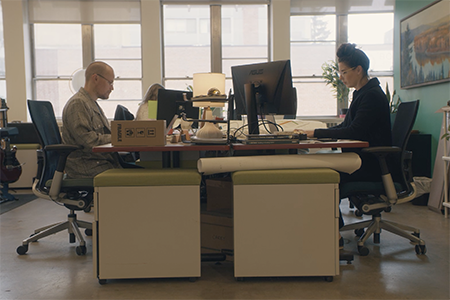
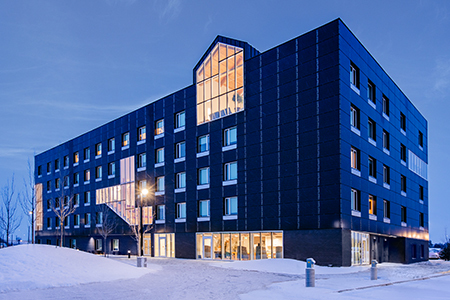
Last July, on a Sunday afternoon, there was a small electrical fire in Air Handling Unit #2 in the Water Centre building, a recently completed sustainable office building in the City of Calgary. Fire-fighters battled smoke and put the fire out quickly. Damage was limited to the air handling unit. Smoke and water damage were minimal. In most office buildings, one of three air handling units being out of commission in the middle of the summer would have meant a complete shut-down of the building. It was seven months before the air handler was working again. Surprisingly, the building re-opened first thing on the Monday morning after the fire, and remained open ever since. There was no lost time.How was that possible?

The secret is that the Water Centre is a 175,000 sf office building with opening windows. The 650 staff who work there were able to open their windows, and fresh Alberta air kept the building comfortable, through the summer, fall and into the winter. We've learned a number of things about designing green and sustainable buildings, over the past fifteen years.

Lessons learned are that the design of the walls, windows and roof of buildings are the most important elements in saving money and energy. Buildings use over 30% of all of Alberta's electricity, and by reducing the energy consumption of buildings like this one, by over 60%, we can dramatically lower costs as well as our carbon footprint.

The challenge is that there are many more existing buildings than there are new buildings. So for every new, sustainable office building we design, we have to consider the impact of hundred of existing towers, with millions of square feet of office space. What can be done to improve existing buildings?

Applying the lessons from new buildings, we imagine that the skin or envelope of the building is the critical puzzle-piece. If we can re-imagine the skin of the building, add better windows and more insulation, we should be able to save energy, improve workplaces and enhance the appearance of some of our existing buildings. We might even be able to get windows that open.

Interestingly, the question of what to do with inefficient large buildings is being asked in many places. And, there are some exciting answers emerging, pointing to the next frontier in sustainable building design. In Toronto, Mayor David Miller launched the Mayor's Tower Renewal Project last fall. Speaking recently in Edmonton, Mayor Miller talked about the importance of this renewal, focused on residential towers, both to enhance the City's residential neighbourhoods and to reduce the city's carbon footprint.

In New York, the iconic Empire State Building has been the subject of an intensive renewal plan, being implemented by a real estate and technical partnership. Included in that integrated strategy, are new windows, insulation, upgraded lighting and building controls, and a projection of 38% energy savings, or annual energy savings projected at over $4 million.

Around the world, public and corporate owners are seeing re-skinning existing buildings as a way to extend the life of existing assets, enhance the interior work environment by adding daylight and opening windows, and improve the city-scape or street-scape, and of course, to save energy. Blending leading architectural and engineering approaches, insulating walls, and opening windows, better daylight controls and lighting, better energy technologies and building systems, allows for cost-effective renovations that save money, energy and enhance asset value. In Edmonton, Manasc Isaac has recently launched www.re-imagine.ca, an initiative to showcase the opportunities created by "greening" existing buildings, by re-imagining their appearance and their performance. Starting with the not-very-old old former Dell building, the Servus Credit Union is among the first to really re-imagine an existing building.  Adding new glazing and daylight through an atrium , this building will soon be warm, durable and light-filled, and use far less energy to operate. Other buildings in Edmonton point to the possibility that hundreds of 1970's towers in Edmonton and Calgary could be re-imagined, and renovated while they are still occupied, over the next decade.

In May of 2005 Ed Mazria launched the 2030 Challenge at the Royal Architectural Institute of Canada's  Festival of Architecture in Edmonton. In May of 2009, Mr. Mazria, be speaking here again, taking the pulse of the progress made. The 2030 challenge, now taken up by the Royal Architectural Institute of Canada, the American Institute of Architects, the Canadian Green Building Council and the US Council of Mayors, challenges us to reduce energy consumption of buildings by 60% right now, 70% by 2015 and to achieve "Net Zero" buildings by 2030. By re-imaging the skin of buildings, adding insulation and new windows, we can reduce energy consumption to the point where alternate energy sources can be used to achieve net zero buildings. In addition, our cities can become more beautiful and our workplaces more effective. That is the next frontier of sustainable buildings.

- Written by Vivian Manasc for the May 2009 issue of Edmonton Commerce News
Click here to read the online version of the Edmonton Commerce News


Comments...

Click here to comment...

Anonymous